In September 2026 Polymarket launched Polymarket Perps — perpetual futures contracts with up to 20x leverage across crypto, stocks, indices, and commodities. Here's how they work, how they differ from prediction markets, and why leverage demands respect.
A perpetual future ("perp") is a derivative contract that tracks an asset's price without an expiration date. Unlike a prediction market — where a Yes share on an election resolves to $1 or $0 on a fixed date — a perp just keeps running. You open a long (profit if the price rises) or a short (profit if it falls), and the position stays open as long as you maintain enough margin.
Because there's no expiry forcing convergence with the real price, perps use funding payments: periodic transfers between longs and shorts that nudge the contract price back toward the underlying index. On Polymarket Perps, funding settles hourly, with the hourly rate capped at ±4%.
Polymarket announced Perps on September 3, 2026, opening with 10 contracts and expanding to 67 live markets within hours:
Trading runs on a central limit order book (like the prediction markets), and positions are margined in pUSD. One detail power users love: cross-margining — a single balance can support positions across many markets, and the same account balance works for both Perps and prediction markets. That means you can pair an event contract (say, a Fed decision market from our politics guide) with a short on the S&P 500's reaction — all from one balance.
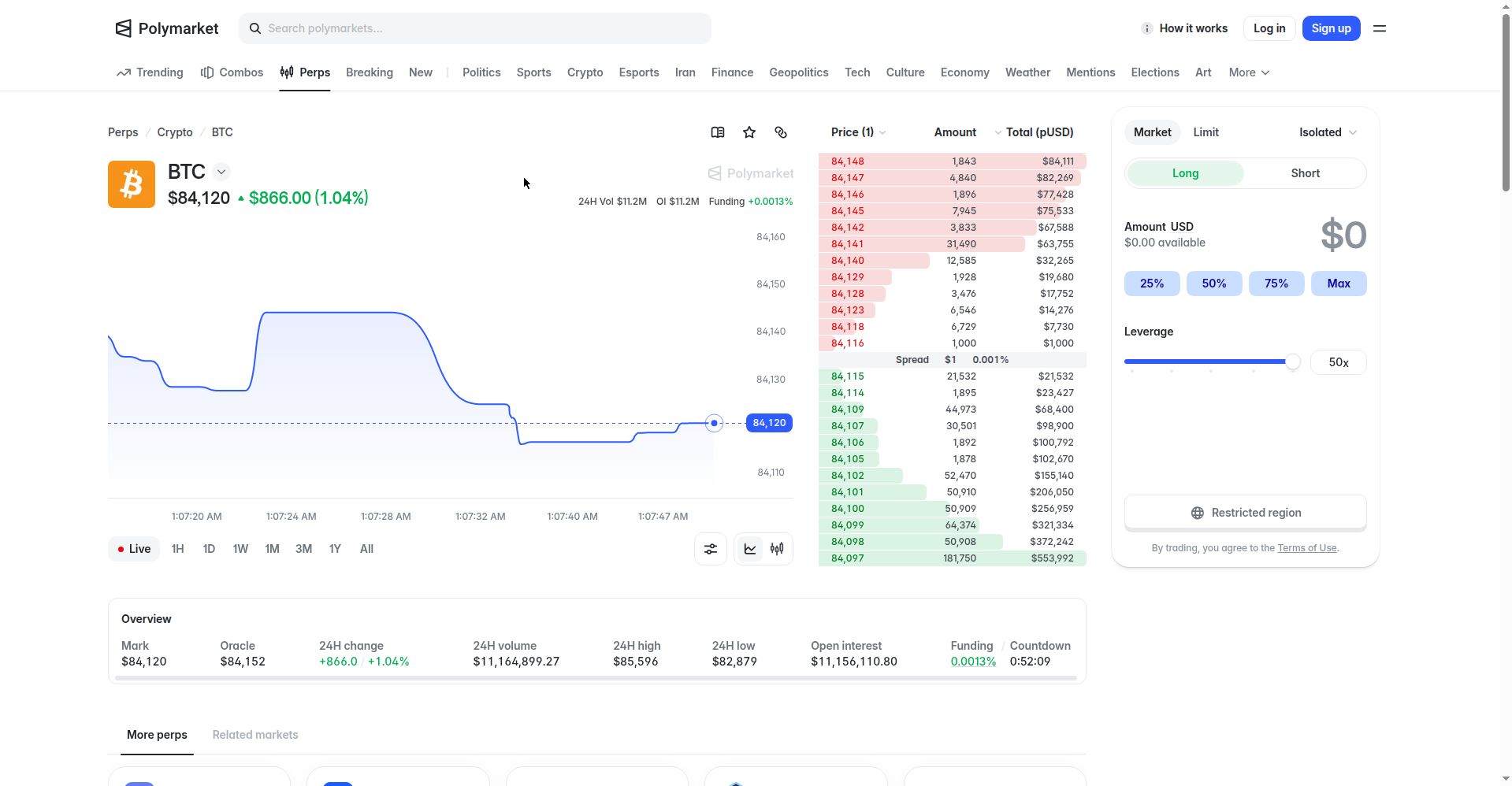
Leverage lets you control a large position with a small deposit — and it magnifies losses exactly as much as gains:
At 20x leverage, a 5% move against you wipes out your margin — that's a liquidation, where the position is forcibly closed and your collateral is gone. Reported fees start at 0.04% taker / 0.0125% maker at standard volume, stepping down for very large traders. Funding is an additional running cost: if you're on the crowded side of a trade, you pay the other side every hour you hold.
Important: Perps are not available in the United States, Canada, or sanctioned jurisdictions. US traders are directed to Polymarket's separate CFTC-regulated exchange (polymarket.us), which offers prediction markets but no leverage. Check our country availability page before planning around this product — access rules for Perps are stricter than for the main prediction markets.
Browse the live perpetuals lineup — crypto, stocks, indices, and commodities.
View Perps on Polymarket PolymarketBro