Everything you need to place your first trade with confidence: how shares work, the two order types, and the market mechanics that affect the price you actually get.
Yes and No shares
Every market asks a yes-or-no question: "Will X happen?" Two kinds of shares exist:
Yes shares pay $1.00 each if the event happens, $0 if it doesn't.
No shares pay $1.00 each if the event doesn't happen, $0 if it does.
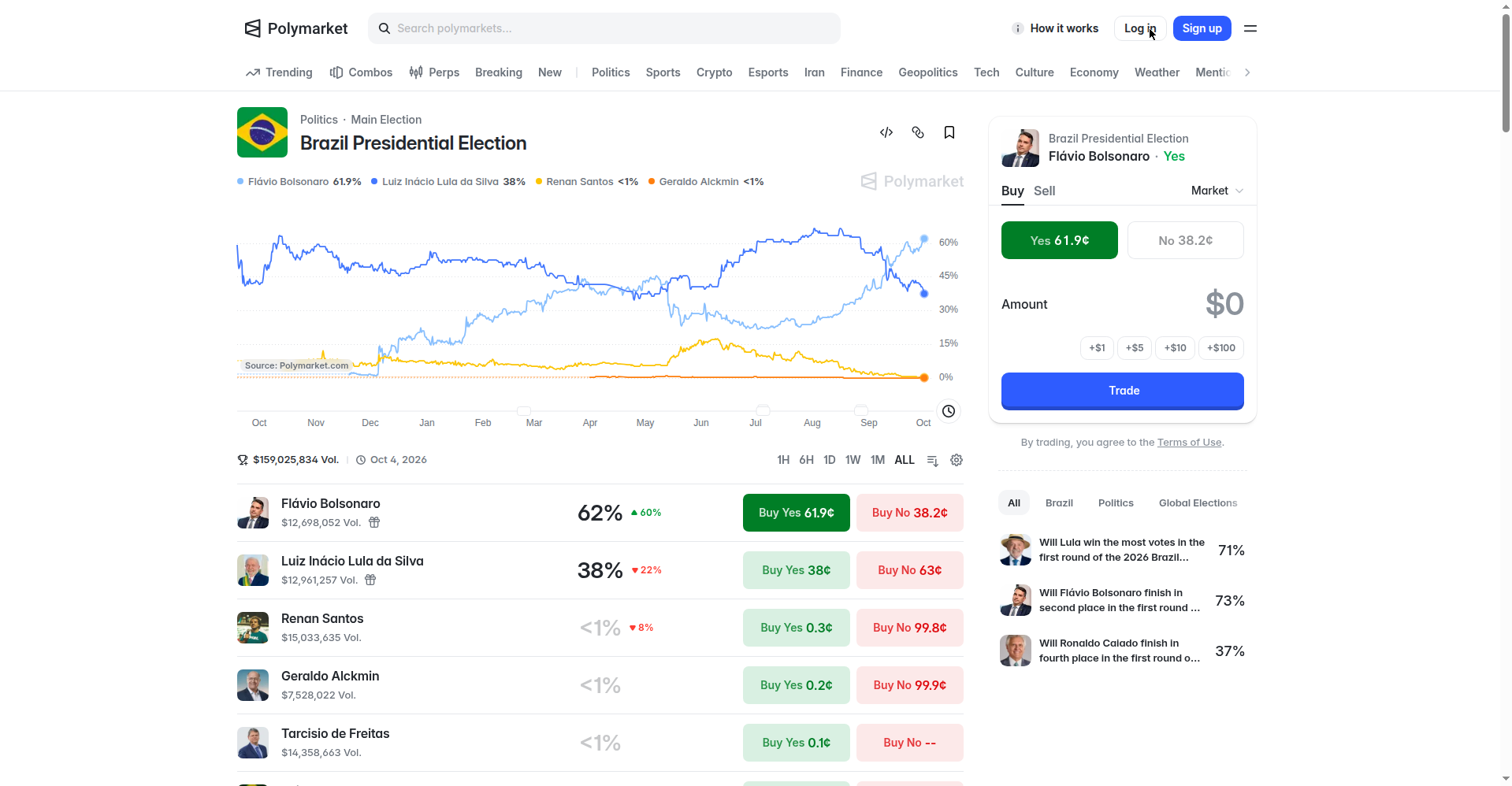
The price of a Yes share is the market's probability estimate. At 62¢, the crowd says there's a 62% chance. Buy Yes at 62¢ and you're risking 62¢ to make 38¢ — the market thinks you'll lose more often than you win, so the payout compensates you when you're right.
Placing your first trade
Pick a market you understand. Subject-matter knowledge beats chart-watching at this stage.
Read the resolution rules at the bottom of the market page — they define exactly what counts as Yes. Ambiguity here is where beginners get burned.
Choose your side: Yes if you think it happens, No if you don't.
Choose an order type (see below), enter an amount, and confirm.
Watch your position. You can sell back at any time before resolution to lock in gains or cut losses.
Screenshot: a real Polymarket market page — price chart, live odds, and the order panel where you buy Yes or No shares. Captured October 2026; prices move constantly.
Limit vs. market orders
Market order: buys immediately at the best available price. Fast and simple, but in thin markets you may get a worse price than displayed.
Limit order: you set the maximum price you'll pay. It only fills at your price or better — but it might not fill at all if the market moves away.
💡 Tip: beginners should prefer limit orders. They protect you from accidentally buying at a bad price during a fast-moving news moment.
Spread and liquidity
Two concepts decide how much trading actually costs you:
Spread — the gap between the best buy and sell prices. A 2¢ spread on a 50¢ share is a 4% round-trip cost before you've made a single good call.
Liquidity — how many shares are available near the current price. Deep markets absorb your trade without moving the price; thin markets shift against you.
Big, popular markets (major elections, big games) usually have tight spreads and deep liquidity. Niche markets can be expensive to trade — check both before committing real money.
When to sell
You never have to hold until resolution. Common approaches:
Take profit early — your Yes shares bought at 40¢ are now 75¢ after good news. Selling locks in the gain without waiting for the event.
Cut losses — the thesis broke. Selling at 20¢ recovers something instead of riding to zero.
Hold to resolution — simplest, but your money is locked up until the event concludes and the market resolves.
⚠️ The beginner trap: buying at 90¢+ because an outcome "feels certain." You're risking 90¢+ to make under 10¢ — one surprise wipes out nine wins. Price always matters more than confidence.
 PolymarketBro